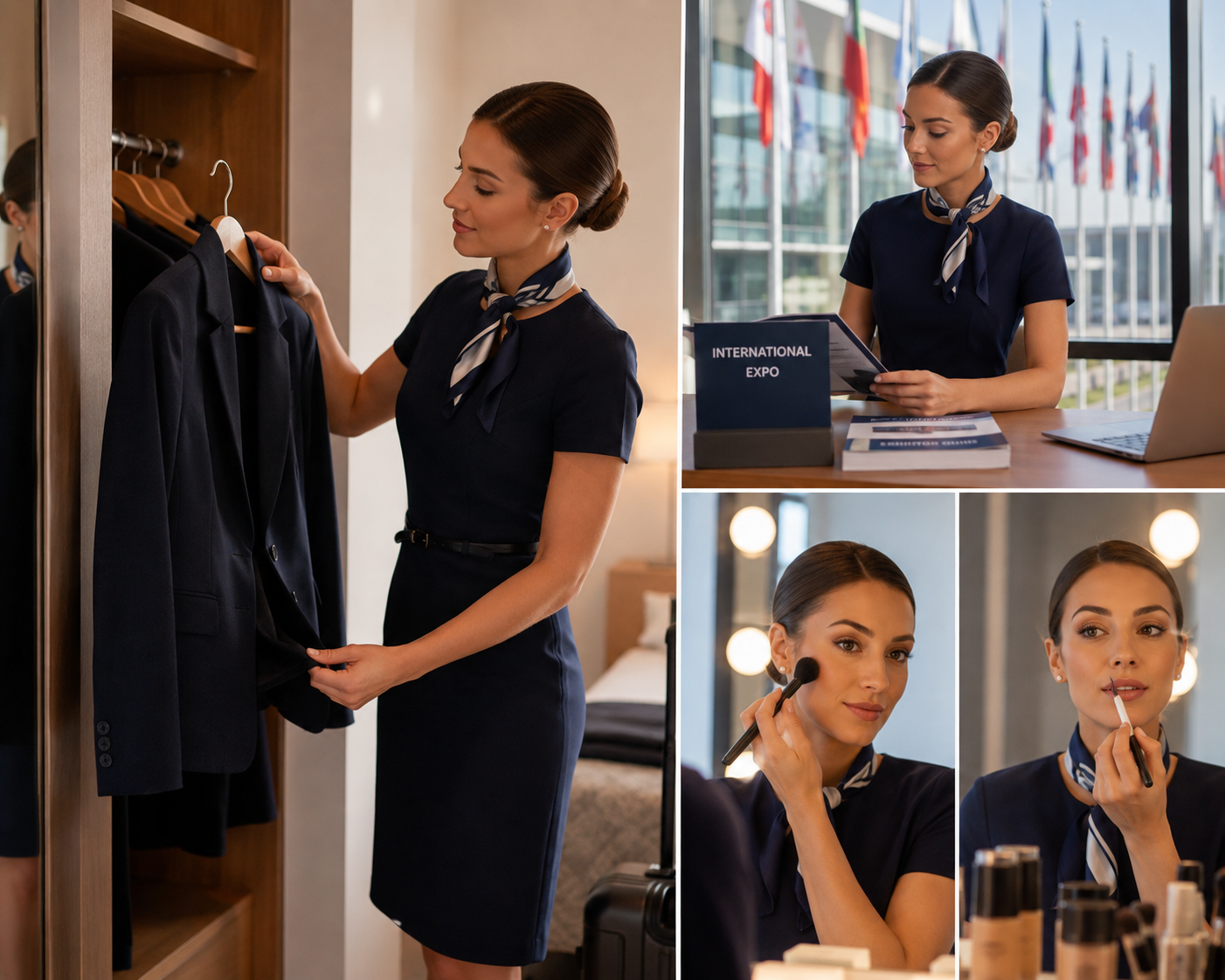

A hostess can wear the perfect outfit, have flawless makeup, and speak multiple languages.
However, she can compromise her entire professional image in just a few seconds simply by looking down at her smartphone while at the booth.
During a trade show, a phone is not a neutral object.
When used in front of visitors, it signals distraction, disinterest, and unavailability. It gives the impression that whatever is happening on the screen is more important than the customer standing at the booth.
The damage does not affect only the person holding the phone.
It involves the represented company, the client who hired the service, and the agency that selected the staff.
A visitor does not know the internal agreements. They do not know if the hostess is replying to a personal message or reading an operational communication. They simply see a person paid to welcome the public who appears focused on something else.
For this reason, the rule must be simple and easily understood:
smartphones must not be used during trade show activities unless there is a genuine operational necessity authorized beforehand.
What Does a Hostess Communicate When Holding a Smartphone?
At trade shows, everything communicates.
It communicates the booth’s order. It communicates how the catalogs are arranged. It communicates the tone of voice of the staff. Posture, gaze, and the ability to notice someone approaching also communicate.
A hostess with her eyes on the phone almost automatically adopts a closed posture.
Her head lowers. Eye contact disappears. Attention to the environment decreases. The visitor must decide whether to interrupt her or walk away.
Many people simply choose not to disturb.
The potential customer passes by the booth and continues on their way. The company might have lost an important contact without even realizing it.
The problem does not change even when the hall seems quiet.
A trade show is never truly empty. There are always visitors observing from a distance, customers deciding which booths to approach, and company managers evaluating the staff's behaviour.
The fact that no one is currently standing in front of the desk does not mean no one is watching.
A hostess who continually checks notifications and messages signals she needs supervision to maintain professional behaviour.
This damages her reputation.
The client may begin to doubt the agency’s reliability. The agency might decide not to offer that resource again. Other team members might be forced to compensate for her lack of attention.
Using a smartphone is also perceived as a form of rudeness.
When a person approaches the booth, they should not have to wait for the hostess to finish writing a message, viewing content, or responding to a notification.
Even quickly putting the phone away upon noticing the visitor does not eliminate the initial impression.
The message has already been conveyed:
I didn’t notice you because I was doing something else.
The same principle applies to earbuds and headphones.
A hostess wearing visible earbuds appears to be engaged in a private conversation or otherwise not fully available. Even when not actually listening to anything, the visitor’s impression remains negative.
Notifications on a smartwatch can cause the same problem when checked continuously. The device changes, but the signal transmitted remains the same.
- signals disinterest towards visitors
- reduces eye contact
- creates a closed and unwelcoming posture
- makes the booth appear neglected
- may drive potential customers away
- damages the image of the represented company
- calls into question the quality of the agency
- weakens the hostess’s professional reputation
- forces other team members to compensate for distraction
- conveys rudeness even if usage lasts only a few seconds
The Professional Rule: Phone out of Sight and Attention Inside the Booth
During an assignment, the personal smartphone should remain silent and out of sight.
The best solution is to keep it in a bag or in the space indicated by the booth’s supervisor.
Keeping it in a pocket is not always enough. Continuous vibration can attract attention and create the temptation to check notifications.
Personal communications should be handled during breaks and away from areas visible to visitors.
Even during breaks, it is preferable not to use the phone while leaning on the desk or standing in front of the booth. A visitor cannot know if the person is on break. They will continue to identify them as part of the company team.
Anyone needing to make a personal call should move away and use a private area.
Of course, there are situations where a smartphone can become a professional tool.
It may be needed to use a client's app, scan a badge, consult a schedule, contact the operations manager, or manage a real emergency.
In such cases, usage must be clearly linked to the activity and preferably agreed upon before the event.
However, exceptions should not be turned into permanent justifications.
Responding to personal messages, checking social media, reading notifications, taking unauthorized photos, or organizing travel during working hours are not operational necessities.
A professional should also inform the supervisor when there is an urgent situation.
A simple phrase like “I need to make a quick urgent call. May I step away for a moment?” demonstrates respect and transparency.
Disappearing without explanation or staying at the booth with the phone at the ear, however, conveys disorganization.
True professionalism lies in understanding that assignment time is not personal time.
The hostess has accepted a specific task and compensation to be present, attentive, and available. She is not paid just for being physically inside the hall.
She is chosen to monitor the booth, welcome visitors, and provide support when needed.
A hostess without a phone in hand notices a person approaching sooner. She maintains a more elegant posture. She smiles naturally. She can intervene without delay.
Above all, she communicates a quality that clients and agencies remember:
I am here and focused on what I am doing.
- keep the phone silent and out of sight
- use it for personal reasons only during breaks
- step away from the booth for private calls
- do not use earbuds during activities
- avoid continuously checking a smartwatch
- ask for permission in case of urgent needs
- use the phone at the booth only for agreed operational activities
- do not take photos without the client's permission
- do not publish booth or visitor content without authorization
- stay present and attentive even during quieter moments
The Smartphone Can Wait. The Visitor Might Not Return
A notification can be read later.
A visitor ignored might not approach again.
At a trade show, everyone at the booth contributes to the company’s reputation. Professionalism is not demonstrated only at important moments. It is most evident in everyday behaviours that no one should need to correct.
Not using a smartphone during activities means respecting the client, the agency, colleagues, and the role accepted.
It also means protecting one’s own reputation.
A attentive hostess is remembered as reliable. A hostess constantly on the phone is remembered for the opposite reason.
Prima Hostess selects professionals for individual autonomous assignments during trade shows and events in Germany and other European countries.
Experience, language skills, and appearance can help obtain an initial opportunity.
Presence, seriousness, and professional conduct determine the chance of being selected again.
So the rule remains simple:
at the booth, eyes must be on visitors, not on the smartphone.