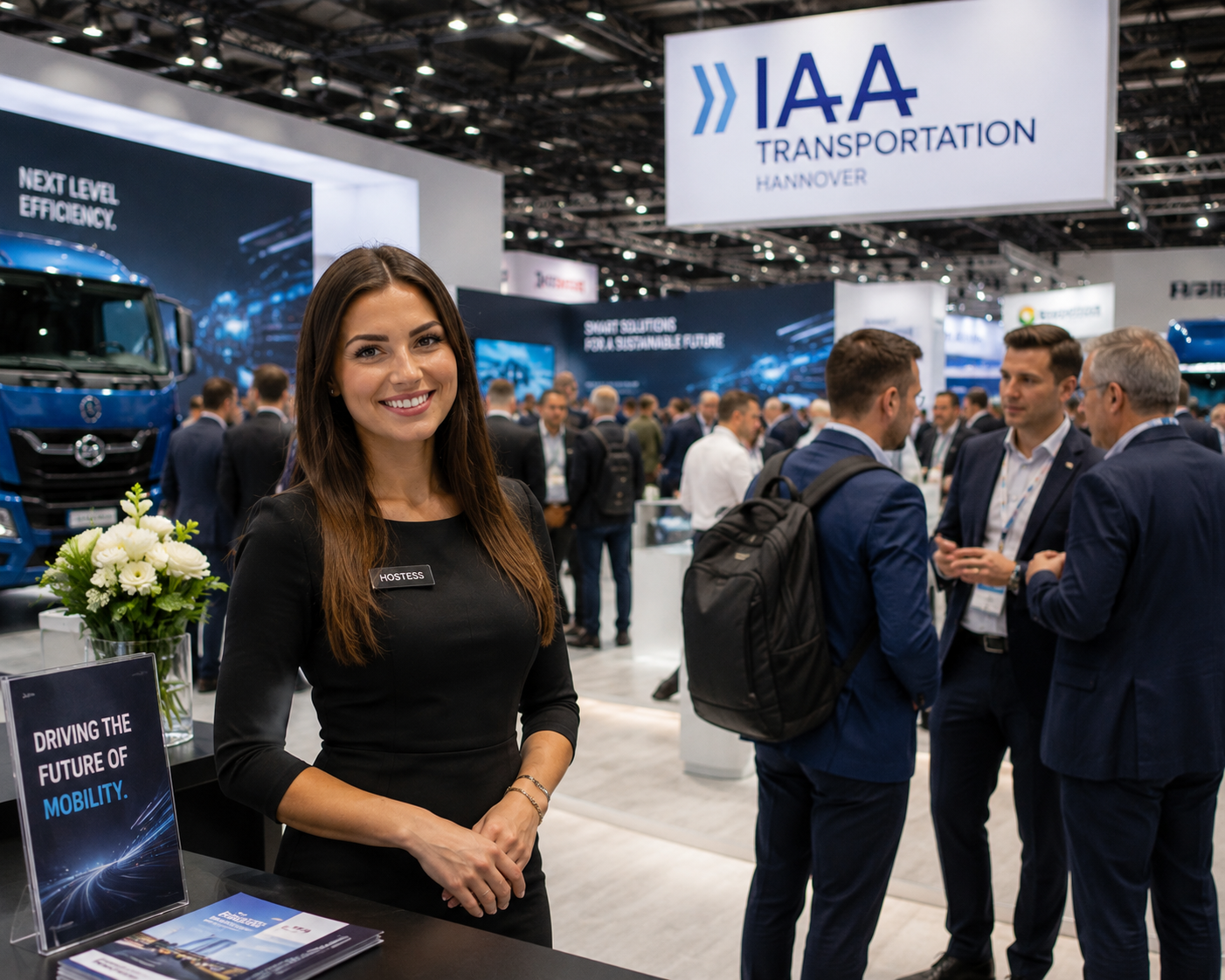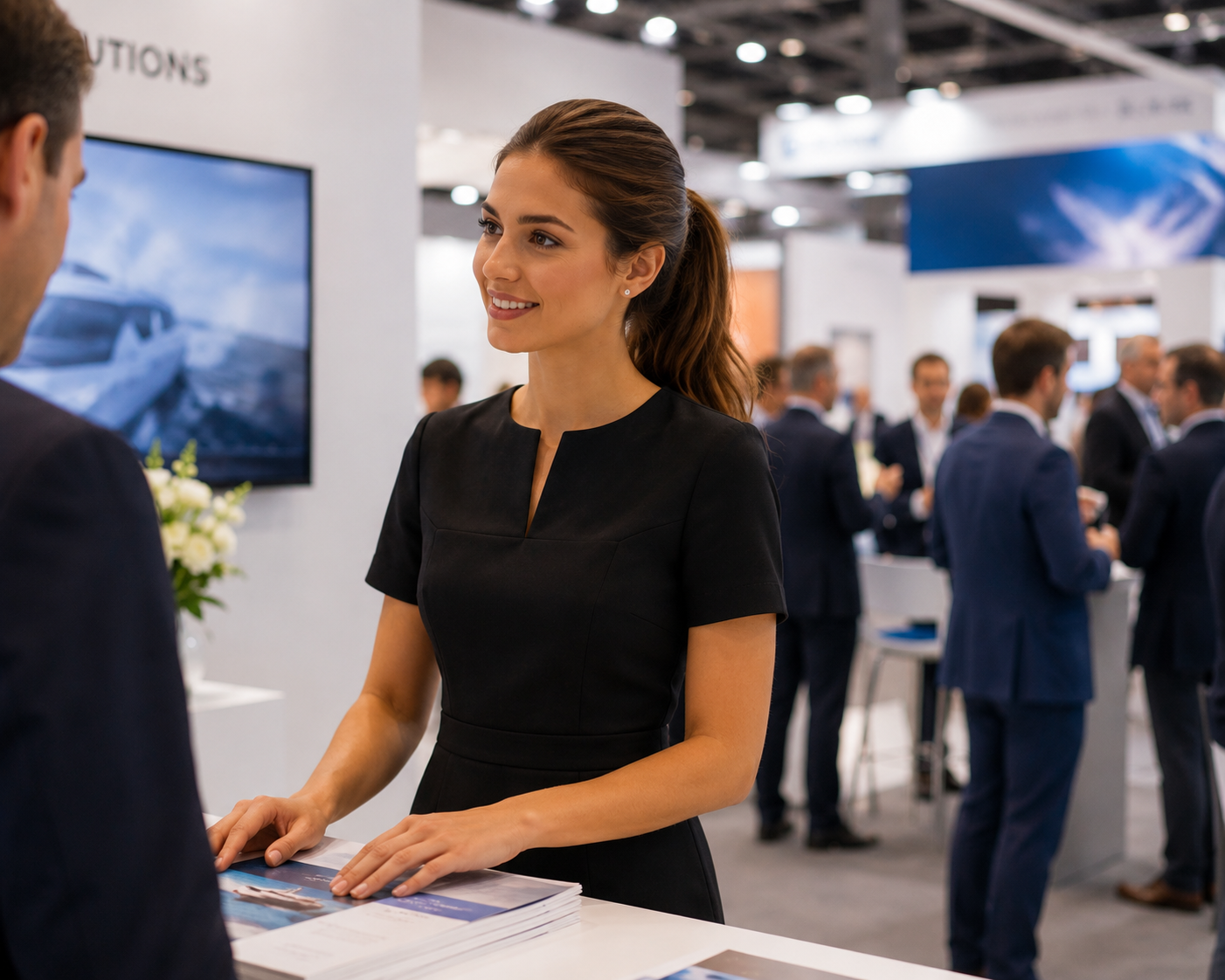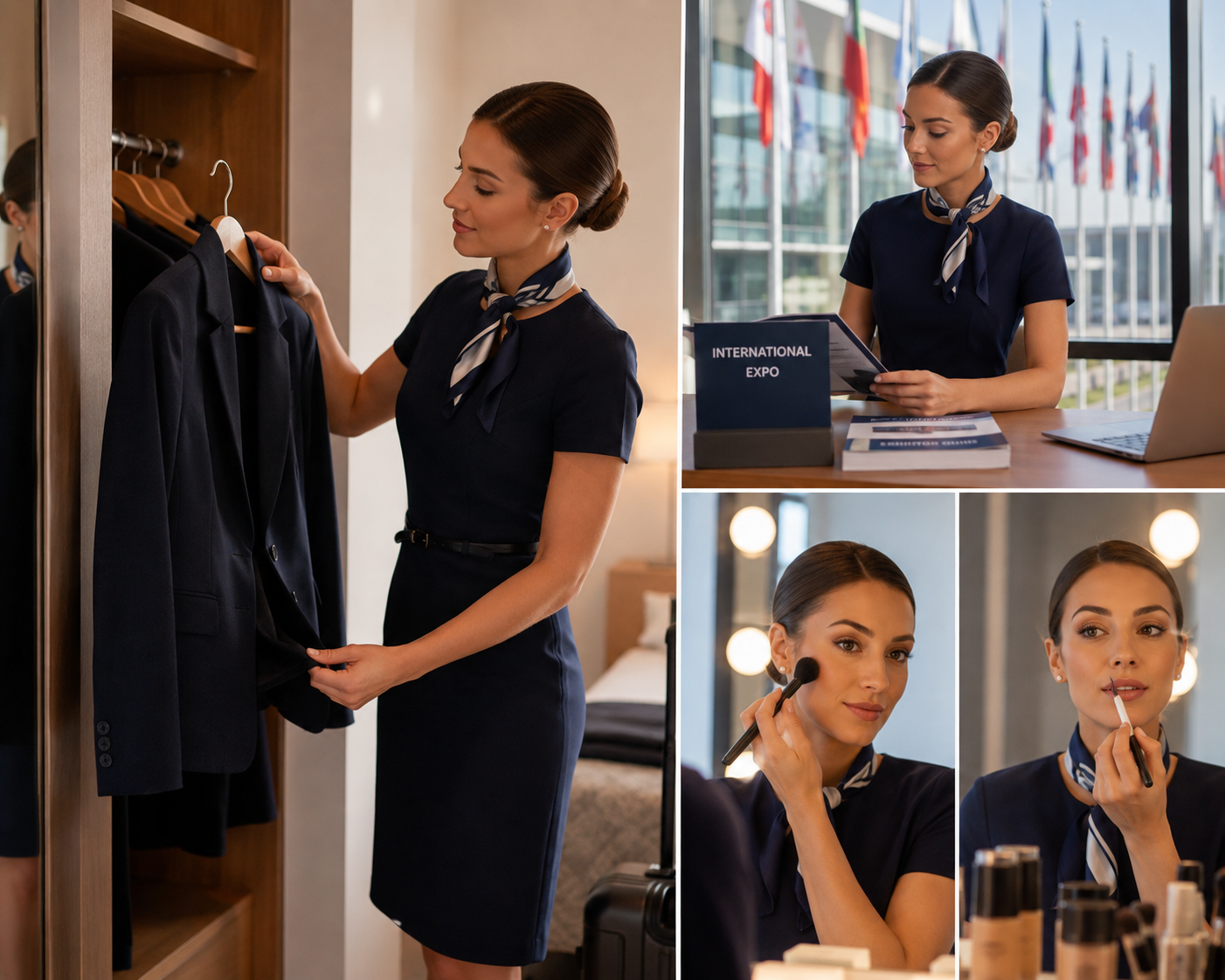
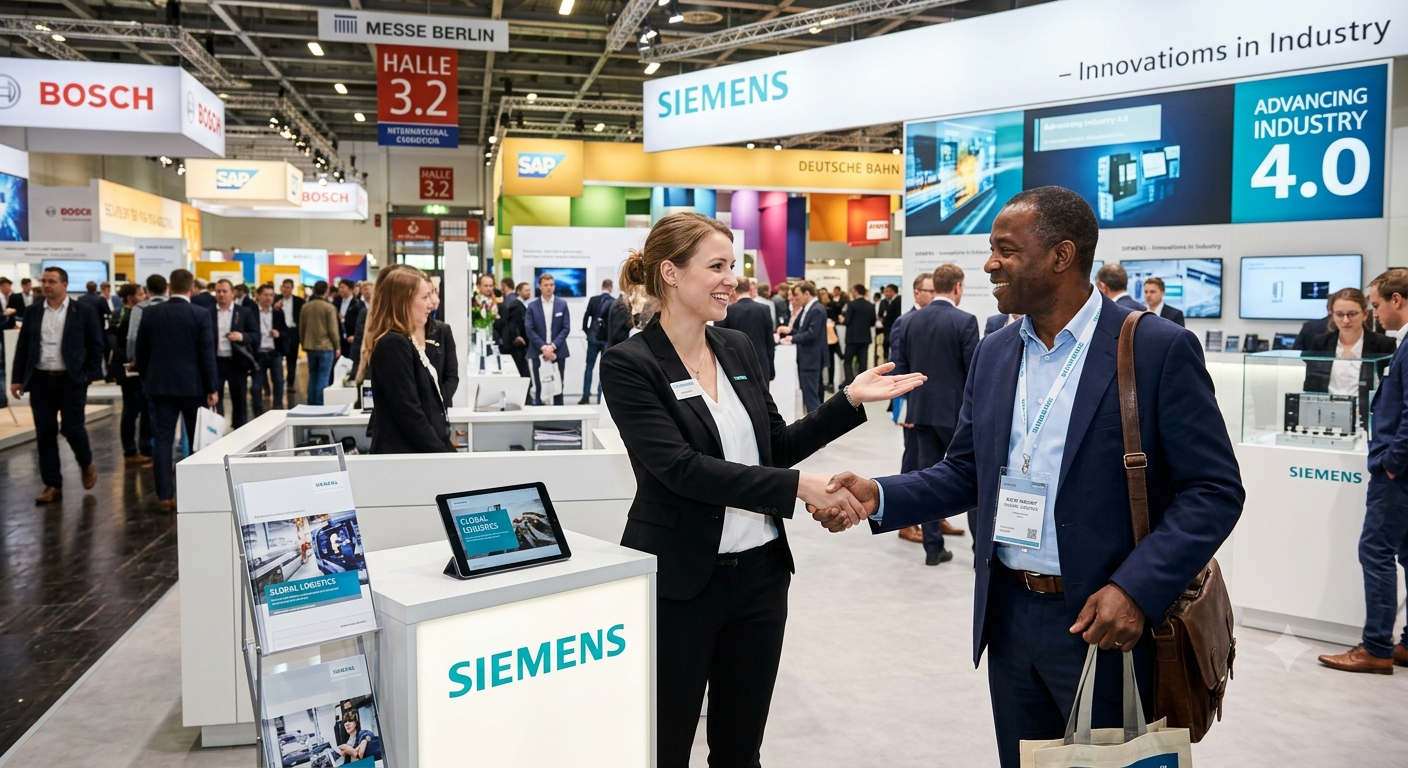
A successful trade fair booth is not simply a beautiful space filled with products and brochures.
It is a temporary business environment where hundreds of small interactions can influence the commercial result of the entire event.
A potential customer may approach the booth while every sales representative is already engaged. A distributor may ask a simple question before deciding whether to stay. An international buyer may hesitate because nobody appears ready to welcome them in the right language.
In each of these moments the people managing the first contact can make the difference between a missed visitor and a valuable business opportunity.
Professional trade fair staff should therefore not be considered a decorative addition to the booth. Hostesses and stewards and promoters and interpreters can become part of a structured visitor management system that supports the sales team and improves the quality of every interaction.
The objective is not to speak with as many people as possible. The objective is to recognise the right visitors and understand what they need and connect them with the right person before their attention moves elsewhere.
This guide explains how companies can build a more effective trade fair staffing strategy and use professional exhibition personnel to transform booth traffic into organised commercial opportunities.
Why the First Contact at a Trade Fair Has Commercial Value
Trade fairs create a unique business situation.
Potential customers and distributors and suppliers and competitors and journalists may all enter the same booth within a few minutes. Each person arrives with a different level of interest and a different objective.
Some visitors already know the company and want to discuss a specific project. Others are comparing several suppliers. Some are simply collecting information while others may represent an important opportunity that is not immediately obvious.
The first person who welcomes the visitor should therefore do more than smile and offer a brochure.
A professional hostess should create an immediate sense of attention and understand the basic reason for the visit. She should then guide the person towards the most suitable next step.
This does not mean replacing the sales team or providing technical advice without the necessary knowledge.
It means managing the space between arrival and commercial conversation.
That space is often where opportunities are lost.
A visitor who is ignored may leave within seconds. A buyer who is sent to the wrong person may decide that the company is poorly organised. A promising contact whose details are not recorded may disappear after the exhibition.
Professional booth staff can help prevent these situations by applying a simple visitor journey:
This process improves the experience of the guest and protects the time of the sales team.
The most experienced commercial managers should not spend the entire day explaining where the coffee area is located or searching for brochures or registering guests. Their attention should remain focused on conversations that require product knowledge and decision making and negotiation.
Professional exhibition staff can manage many supporting activities while keeping the booth welcoming and organised.
Language skills are another important part of the first contact.
German trade fairs attract visitors from across Europe and the rest of the world. German and English are frequently required while Italian and French and Spanish and other languages may become valuable according to the target markets of the exhibitor.
A visitor who can express an initial request in a familiar language may feel more comfortable and may provide more useful information.
The level of language proficiency should always match the assignment.
Conversational knowledge may be suitable for reception and hospitality. Commercial support and technical conversations and interpreting require more advanced skills.
The quality of the first contact also depends on preparation.
Even an experienced hostess cannot represent the company effectively without a clear briefing. She should understand what the company offers and which visitors are most relevant and who is responsible for each subject.
A good briefing does not require the hostess to become a technical specialist. It gives her the information needed to recognise situations and respond correctly.
- welcome every visitor without creating pressure
- ask a simple opening question
- understand whether the visitor is a customer or distributor or supplier or general guest
- identify the most suitable company representative
- collect contact details when necessary
- manage waiting visitors professionally
- provide basic information approved during the briefing
- support communication in the required languages
- keep reception and hospitality areas organised
- record important requests for later follow up
The Staffing System That Helps Convert Booth Traffic into Qualified Opportunities
An effective trade fair staffing strategy begins before the exhibition opens.
The first step is to define what the company wants to achieve.
Some exhibitors want to meet distributors. Others want to present a new product or enter the German market or generate appointments or strengthen relationships with existing customers.
The staff selection and briefing should reflect these objectives.
A hostess assigned to a product launch may require strong presentation skills and an energetic communication style. A hostess working at a technical industrial exhibition may need excellent organisational abilities and confidence when speaking with engineers and purchasing managers.
A food and beverage event may require staff who can support tastings and maintain hygiene and present products enthusiastically.
The second step is to define the roles inside the booth.
Every confirmed professional should know which tasks belong to them and which tasks must remain with the company team.
A hostess can welcome visitors and qualify the initial request and organise appointments and support hospitality activities.
A promoter can approach visitors more proactively and introduce a campaign or product.
A steward can assist with access control and visitor flows and operational activities.
An interpreter can support professional conversations when advanced language skills are required.
A team leader can help coordinate larger groups during complex events.
The third step is to establish a clear handover process.
When a relevant visitor arrives the hostess should know exactly who must be contacted.
A purchasing manager interested in distribution may need to meet the export director. A journalist may need the marketing manager. A visitor asking a technical question may need a product specialist.
Without this preparation even a professional team can create confusion.
The fourth step is to decide what information should be collected.
A stack of business cards is not a lead management system.
The company should decide which details are important and how contacts should be classified. The hostess may record the person’s company and role and country and area of interest and urgency.
A simple classification can help the sales team identify priorities after the event.
For example:
Priority A may indicate an immediate commercial opportunity.
Priority B may indicate a relevant contact requiring further information.
Priority C may indicate a general enquiry or long term possibility.
The classification method should remain simple enough to use during busy periods.
The fifth step is to select personnel according to the real assignment and not only according to appearance.
Professional image remains important because every person at the booth represents the brand. It should however be considered together with experience and language skills and reliability and location and communication ability.
Local personnel can offer additional organisational advantages.
Hostesses based near the exhibition city can normally reach the venue independently and often do not require hotel accommodation. This can reduce costs and avoid complications connected with long distance travel.
Local staff are also familiar with the professional environment in Germany and the practical organisation of major exhibition destinations.
Prima Hostess selects local and multilingual professionals for individual trade fair assignments in leading German exhibition cities including Cologne and Düsseldorf and Frankfurt and Stuttgart and Nuremberg and Munich.
The selection should ideally begin a few months before the event.
During major exhibitions experienced multilingual professionals may receive several requests and become unavailable well in advance.
Starting early allows the company to review a wider selection of profiles and verify language skills and prepare an effective briefing.
The final step happens after the exhibition.
The value of professional staffing does not end when the doors close.
The company should review the collected contacts and compare the results with the original objectives. Feedback from the staff can also reveal useful information about recurring questions and visitor reactions and organisational difficulties.
This information can improve future events.
A trade fair is not only a place where contacts are collected. It is an opportunity to observe how the market responds to the company.
Professional booth staff are often positioned at the exact point where those reactions become visible.
- define the commercial objective of the exhibition
- describe every role before selecting personnel
- identify the ideal visitor profiles
- prepare simple opening questions
- create a clear handover process
- assign company representatives by subject
- define which contact information must be collected
- use a simple lead classification system
- verify language levels according to the tasks
- select local staff when appropriate
- prepare a written briefing before the event
- review contacts and feedback immediately after the exhibition
Your Booth Should Never Lose a Valuable Visitor
Trade fair success depends on products and presentation and commercial preparation. It also depends on how visitors are welcomed and understood and guided through the booth.
The right personnel can protect the time of the sales team and improve the visitor experience and help the company recognise valuable opportunities that might otherwise be missed.
Prima Hostess selects local and multilingual hostesses and stewards and promoters and interpreters for individual trade fair assignments across Germany.
Each selection is based on the city and event and required languages and planned activities and profile characteristics requested by the client.
Send us the exhibition name and location and dates and working hours and required languages and expected duties.
After checking the availability of suitable professionals we will prepare a clear proposal. When the quotation meets your requirements the first available profiles can generally be presented within 24 to 48 hours.